
Decoding Your Inner Rhythm: The Science Behind Your Emotional Frequency Signature
Your awareness is the gentle key that opens the door to transformation.
Have you ever noticed how some days your spirit feels light and open, while on others, everything feels heavy and constricted? This inner shift is more than just a passing mood. It’s a reflection of your emotional frequency—the subtle energetic rhythm created by your thoughts, feelings, and overall state of being. Every emotion carries its own unique vibration, and together, these create the emotional frequencies you move through each day.
Perhaps you recall a morning where you woke up with a sense of hope, or maybe conversely, a time you felt weighed down before your day had even begun. Where on this spectrum do you find yourself most often? This awareness is not only the beginning of emotional understanding—it’s what can gently lead you back to balance.
“When you start to notice the frequency of your emotions, you begin to witness the language of your inner world.”
Modern psychology, ancient wisdom, and even emerging neuroscience all point to a similar truth: your emotional landscape isn’t random. Think of the last time you were caught in a spiral of self-doubt, or felt a fleeting wave of relief after a single deep breath—that’s emotional energy in motion. It follows distinct emotional patterns, influences your perception, and deeply shapes how you experience your life. Have you noticed how these subtle shifts show up for you?
Have you felt moments like this recently? Where do you notice yourself on this ever-changing spectrum of emotional vibration?
Understanding the frequency of emotions doesn’t require complex scientific knowledge or years of spiritual study. It begins with gentle awareness, tuning in to the subtle stories your feelings tell each day.
Once you learn to recognize how your emotional vibration works, you can start to see what lifts you, what drains you, and what lovingly guides you back to a state of inner balance. It’s a journey of coming home to yourself, one feeling at a time.

What Exactly Is Emotional Frequency?
At its heart, emotional frequency is the vibrational “tone” that your emotional state creates. Just as every sound has a unique pitch, every emotion carries a subtle energetic signature. This is why joy feels expansive and light, fear feels tight and constricting, and gratitude feels warm and open. These sensations aren’t just in your head—they reflect real, tangible changes happening within your body and mind. Have you ever become aware of the shift in your own body when a kind word softens your shoulders or a painful memory tenses your chest? Noticing these physical cues is part of tuning in to your own emotional vibration.
Have you ever paused to notice which emotions are most present for you lately? What would happen if you simply observed, without judgment, the subtle changes in your energy throughout the day?
So, what does emotional frequency mean in the simplest terms? It’s the beautiful dance between your thoughts, feelings, and physiological responses, all working together to create a specific energetic rhythm. When you hear people talk about “raising your vibration,” this is what they are referring to: gently shifting into an emotional state that holds a higher, more harmonious frequency.
From a light scientific perspective, your emotional frequency is connected to how your nervous system behaves. Different emotions influence your heart rate, breathing patterns, hormone levels, and even the subtle electrical signals in your brain. These biological patterns—your emotional energy—shape how open, calm, or reactive you feel in any given moment. A sense of peace, for example, can create what is known as emotional coherence, where your heart and brain rhythms become more synchronized and stable.
From a spiritual or energetic perspective, emotions exist on a spectrum. Lower-frequency states like shame, guilt, or fear feel heavy because they contract your energy inward. Higher-frequency states like love, joy, or gratitude feel uplifting because they expand your energy outward. This is your emotional vibration in action: a blend of biology and subtle energy responding to your inner world.
Do Emotions Have Frequencies? The Science and Energy Behind It
A natural and important question often arises when exploring this topic: do emotions truly have measurable frequencies? Imagine walking into a room and instantly sensing tension, or feeling calm wash over you while sitting quietly in nature—these are everyday encounters with the energy of emotion, even if we can’t quantify them with tools. How do these subtle shifts show up for you in your daily experience?
The answer is both scientific and energetic, and it’s beautifully simple. While you can’t measure an emotion with a tuning fork, you can observe its powerful effects on the body. Have you ever noticed your breath quicken or your heart beat faster when anxiety rises? Or how relief and peace seem to soften your whole body after a moment of acceptance? These felt experiences are vivid demonstrations of emotional frequency at work.
Where in your daily rhythm have you felt the wave of a certain emotion shift your energy?
From a scientific viewpoint, emotions create very real, observable changes. When you feel fear or stress, your nervous system shifts into a protective fight-or-flight mode. Your breathing becomes shallow, your heart rhythm changes, and your brain produces faster, more erratic electrical patterns. These biological shifts create identifiable rhythms—what many describe as the frequency of emotions. In contrast, higher emotions like joy, gratitude, and love activate calmer, more coherent and harmonious rhythms in the heart and brain.
From an energetic or spiritual perspective, the concept of emotions and their frequencies reflects how open or contracted your inner state feels. Have you ever noticed how shame makes you want to shrink, while joy makes you feel expansive? Low vibration emotions tend to pull your energy inward, making life feel heavy, small, or restrictive. High vibration emotions expand your awareness, helping you feel lighter, clearer, and more connected to the world around you.
Both perspectives work together to explain why your emotional frequency is so important: your inner state quietly shapes your thoughts, your behaviors, and even how you interpret your reality. So, yes, emotions do have frequencies—not in a literal, acoustic sense, but as a powerful blend of biological rhythms and energetic signatures that influence how you feel, function, and relate to life.
The Emotional Frequency Scale (Levels of Emotions)
Every emotion is an invitation to gently realign with your inner wisdom.
To truly grasp how emotional frequency works, it helps to visualize emotions on a spectrum. Just as the subtle tunes of music can play high or low, our feelings shift along their own emotional scale. This is often called the emotional frequency scale—a gentle map that shows how different emotional states carry different energetic and psychological effects.
Have you ever paused to notice when your mood begins to lift or slide? Think of this scale as a ladder of consciousness: some emotions lift your inner state upward into expansion, while others guide it downward into contraction.
Where do you imagine yourself on this ladder right now?
At the lower end of the scale are states like shame, guilt, fear, and apathy. These low vibration emotions feel heavy because they narrow your focus and activate protective, survival-based responses in your nervous system. They represent the denser end of the emotional spectrum, where your emotional energy feels slow and turned inward.
Near the middle of the scale, you’ll find transitional states like courage, acceptance, and willingness. These are the pivot points where your inner world begins to reorganize itself. They create openings, helping you shift from a place of contraction toward one of gentle expansion.
Your emotions carry energy, and that energy affects how you think, feel, act, and attract experiences into your life.
At the higher end of the scale are the high vibration emotions: love, joy, gratitude, and peace. These states generate more harmonious and coherent patterns in your heart and mind, uplifting your overall frequency of emotions. They expand your awareness, elevate your perspective, and create more resilient emotional patterns. When people talk about learning how to raise your emotional frequency, they are referring to this journey of moving upward through these levels—not by forcing positivity, but by gently understanding and working with the emotions you already have. Simply recognizing where you are on the scale is the first step in shifting your energy.
Emotional Frequency Chart (Explained Simply)
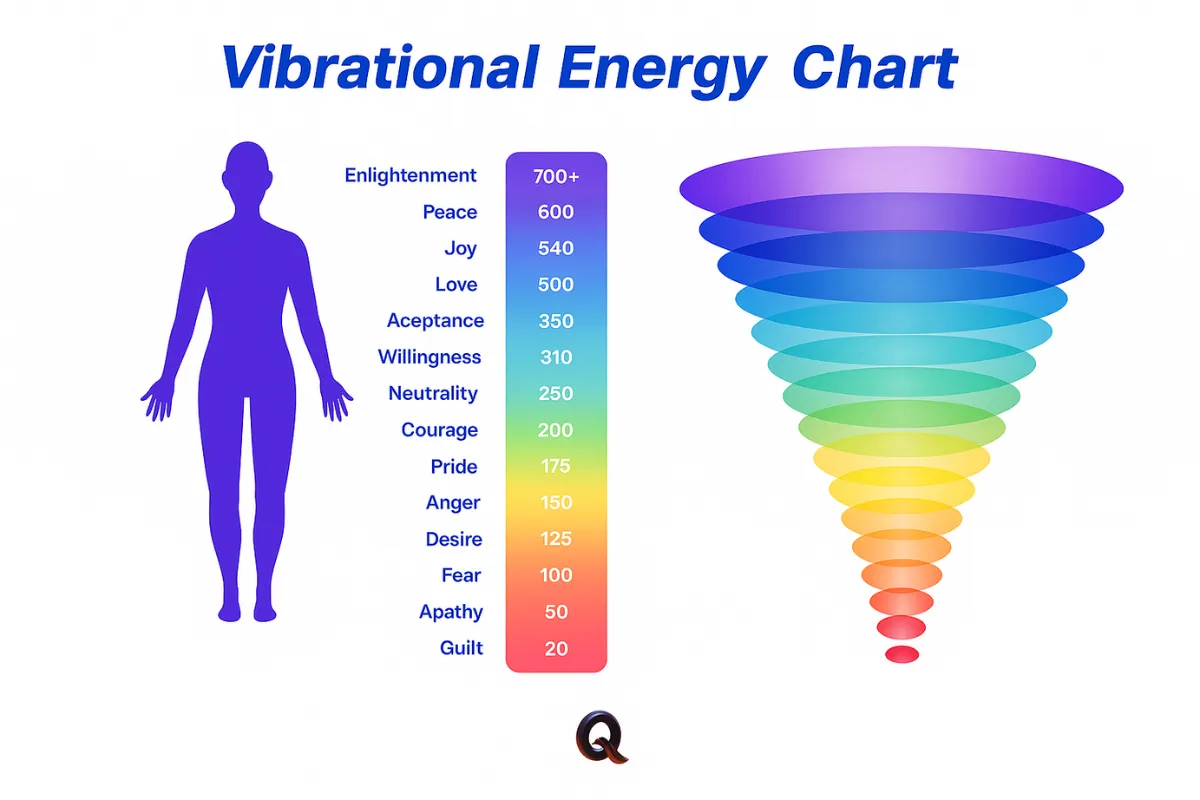
An emotional frequency chart makes this whole concept feel much more practical and less abstract. Imagine a moment when you glanced at a friend’s face and instantly sensed heaviness, or recalled that gentle inner lightness that follows after someone genuinely listens to you—these are small glimpses into your personal frequency map. While different teachers may illustrate it in slightly different ways, the core idea behind every chart is the same: emotions exist on a spectrum, and each state carries its own unique energetic pattern. Think of an emotion frequency chart as a map of your inner landscape.
Where do you notice yourself landing most often—closer to the dense emotions below, or somewhere in the lighter spaces high above? What does your “chart” look like lately?
At the lower end of the chart, you find dense, contracting emotions such as shame, guilt, fear, and anger. These states often create a tight, closed-off sensation in the body because they activate protective survival responses. Their energetic patterns can feel irregular or chaotic—what many refer to as “lower frequencies.”
Toward the middle of the frequencies of emotions, you’ll see the transitional states like acceptance, courage, willingness, and neutrality. These emotions begin to soften the nervous system, open the breath, and create more internal space for new possibilities to emerge.
Higher up on the chart are the expansive emotions like love, gratitude, peace, and joy. These feelings tend to produce steadier, more harmonious internal rhythms—what are known as high vibration emotions. In spiritual language, these are “higher frequencies,” and in scientific terms, they align with a state of emotional coherence in the heart and brain.
It is deeply important to remember that no emotional frequency chart is meant to judge or rank you. You are not “better” for feeling high emotions or “worse” for feeling low ones. Every emotion is a valid messenger. The chart simply helps you recognize your emotional patterns. Once you can see where you are, you can understand how your emotional frequency shifts throughout the day and gently guide it toward states that feel lighter, clearer, and more supportive of your well-being.
How Emotional Frequency Affects Your Life

As we move from understanding charts and scales to real-life impact, consider how your energetic state is not just an internal event—it’s a living influence that subtly weaves into every relationship, decision, and possibility you encounter. Before diving deeper, it’s important to see how these internal states ripple outward into every area of life. Your daily emotional state does far more than just shift your mood. It quietly shapes your perception, influences your decisions, and even affects the opportunities you notice—or miss entirely. This is where understanding emotional frequency becomes deeply practical. The frequency of emotions you experience most often becomes your internal compass, guiding the way you think, behave, and relate to the world.
Have you observed how a small shift in mood changes the way colors appear brighter, or how even routine tasks seem lighter or heavier? Where have you noticed this effect in your life lately?
When you are operating from lower emotional states like fear, shame, or anger, your mind tends to narrow its focus. Does it ever feel like you see more problems than solutions in these moments? You might react more quickly, feel disconnected from your inner wisdom, or interpret neutral events through a lens of stress. These are common effects of a lower emotional vibration—your nervous system becomes protective, your creativity wanes, and a sense of struggle can color your entire day.
In higher emotional states such as peace, gratitude, or joy, your inner world expands. You think more clearly, communicate more openly, and feel more resilient in the face of challenges. Your heart rate becomes steadier, your breath deepens naturally, and your mind organizes information with greater ease. This upward shift in your emotional frequency changes not only the way you respond to life but also how life seems to respond to you.
Even small, gentle improvements in your emotional state can profoundly influence your choices, relationships, and overall sense of well-being. You become more patient, more intuitive, and more present. You start recognizing possibilities that previously felt out of reach. Over time, these subtle shifts compound, shaping the direction of your life in beautiful and meaningful ways.
Emotional Frequency in Relationships and Decision-Making
Your emotional frequency doesn’t just shape how you feel internally—it powerfully influences how you connect with others and how you make everyday decisions. For instance, think about a day when everything felt like a struggle: maybe a coworker’s neutral comment seemed loaded, or a simple request from a loved one felt overwhelming. In these moments, when your emotional frequency is low, you might find yourself interpreting neutral situations more negatively, assuming the worst in a conversation, or responding from a place of tension. Discussions can feel heavier, misunderstandings may happen more easily, and even the smallest triggers can spiral because your nervous system is already in a contracted, defensive state.
Have you ever caught yourself replaying a conversation and wondering why it felt so difficult? What if those moments were signals from your system about your current emotional state?
In higher emotional states, your perception softens and expands. You listen more openly, communicate with more patience, and respond from a place of centeredness rather than reacting from a wound. Decisions feel clearer because your mind is not clouded by survival-based emotions. You naturally begin to choose actions aligned with your long-term well-being instead of seeking short-term relief from stress. This is one of the most practical effects of emotional frequency: it directly shapes how you see people, how you solve problems, and how confidently you move through your daily life.
Signs Your Emotional Frequency Is Low
It’s comforting to remember you are not alone—everyone’s emotional frequency ebbs and flows, and moving through lower states is simply part of being human. Please know, you’re not doing anything wrong if you find yourself here; your emotions are simply offering information and seeking your care. Still, it can be deeply empowering to recognize the signs that your emotional frequency is lower than usual —much like recognizing the signs of a low money vibration when your financial energy feels stuck. With this gentle awareness, you can guide yourself back to balance, without judgment or pressure.
Have you noticed days when heaviness settles in for no obvious reason? Are there moments where joy feels distant or motivation slips away? Such patterns can be subtle guides; small invitations to check in with your mind, body, and heart. As you explore the following signals, notice which ones quietly resonate with your own experience. Where do you sense these states in your life right now?
A Sense of Heaviness or Fatigue
One of the clearest signs of a low emotional vibration is a persistent feeling of heaviness. You may feel tired even after a full night’s rest, or notice that everyday tasks require much more effort than usual. Emotions like shame, guilt, fear, or resentment—commonly considered low vibration emotions—tend to create a contracting effect in the body. Your breath may become shallow, your shoulders might tense up toward your ears, and your mind can get stuck looping through the same thoughts without finding a resolution.
Feeling Disconnected or Irritable
You might also feel disconnected from yourself or from others. Conversations may feel draining, prompting you to withdraw socially. Or, you might experience a short fuse, where small annoyances trigger a surprisingly strong reaction of irritation. These patterns are not character flaws; they are simply signals from your nervous system that it is overwhelmed and asking for support and regulation.
A Lack of Joy or Motivation
Another indicator is a noticeable difficulty in experiencing joy, inspiration, or motivation. Activities that once felt uplifting may now seem neutral, flat, or uninteresting. Your creative spark can feel dim, mental clarity may fade into a fog, and your inner world can feel cluttered and chaotic. This isn’t because something is wrong with you—it’s simply your system operating from a place of protection rather than expansion.
Signs Your Emotional Frequency Is High
Just as lower states create a feeling of heaviness, higher states bring a beautiful sense of lightness and expansion. When you’re in a high emotional frequency, life feels clearer, more connected, and flows with more ease. Perhaps you’ve found yourself humming along with the world for no particular reason—a simple sunrise, a warm cup of tea, a heartfelt laugh suddenly lighting up your whole body. These moments of inner alignment aren’t random; they are a direct reflection of your inner system shifting into a state of harmony and coherence.
How do you notice these subtle lifts—do small joys find you more easily, or do you spot gentle synchronicities throughout your day? Noticing these signals is a reminder that you are constantly in motion within your own inner energy field. Are there times when you’ve paused and thought, “Wow, I feel truly at peace right now?”
Emotional Steadiness and Resilience
One of the first signs of operating from high frequency emotions is a sense of emotional steadiness. You don’t get swept away by external events or react as quickly or intensely to triggers. Instead, you find yourself able to pause, breathe, and respond from a grounded, centered place. Even when challenges appear, there’s a quiet inner knowing that you can handle them.
Mental Clarity and Intuitive Flow
You may also notice greater mental clarity. Ideas seem to flow more easily, decisions feel more intuitive, and your mind organizes information with less effort. This is a common and wonderful effect when high vibration emotions like joy, gratitude, or love create coherence in your nervous system and heart rhythm, allowing your mind to function at its best.
A Feeling of Presence and Connection
Another beautiful sign is feeling more present in your own life. You are naturally more patient, more attuned to your environment, and more genuinely connected in your conversations. Small moments begin to feel deeply meaningful—the warmth of sunlight on your skin, a kind word from a stranger, or the simple peace of a deep breath. Your body also gives you signals. Your breath deepens, your muscles soften, and your chest feels open rather than tight. These physical cues are your body telling you that your emotional frequency is rising.
How to Raise Your Emotional Frequency

Learning how to raise your emotional frequency isn’t about forcing positivity or trying to suppress difficult feelings. Instead, picture it as an invitation—one where you gradually, lovingly guide your inner state toward balance, clarity, and openness. Each step, no matter how small, builds gentle momentum. You might ask yourself: what is one thing I could do today to feel just a bit lighter or more at ease?
Have you noticed the difference a simple, mindful breath can make after a stressful moment? These are the kinds of small shifts that, over time, can help you build a more supportive emotional rhythm. Small, consistent practices are far more powerful than grand, one-time efforts, as they compassionately retrain your nervous system over time. Here are some simple ways to raise your emotional vibration without pressure.
- Acknowledge Your Feelings with Kindness
Simple awareness is the first and most crucial step. When you pause and name an emotion—”I am feeling anxious right now”—without judging it, you instantly soften its intensity. Acknowledging what’s present signals safety to your brain and begins the process of healthy emotional regulation. - Use Your Breath as an Anchor
Slow, intentional breathing is a direct pathway to calming your nervous system and helps to raise your emotional frequency. Just a few gentle breaths, making your exhales slightly longer than your inhales, can shift your body out of a stress response and into a state of openness within minutes. - Ground Yourself in the Present Moment
Physical grounding is a powerful way to stabilize your emotional energy. Feel your feet firmly on the floor, gently relax your shoulders down from your ears, or sit upright and feel your spine lengthen. Grounding brings you out of swirling thoughts and back into the simple reality of the present moment, where clarity naturally lives. - Find a Micro-Moment of Gratitude
Gratitude is one of the most effective and accessible ways to shift your emotional vibration. It doesn’t have to be for something monumental. Can you notice one comforting detail in your environment? A supportive person in your life? A single moment of relief you felt today? Gratitude gently expands your emotional space and reminds your system of what is good. - Choose One Uplifting Micro-Action
Small actions create powerful energetic shifts. Listen to a piece of calming music, step outside for a breath of fresh air, drink a glass of water with intention, or tidy one small corner of your desk. These micro-actions shift your physiology, which in turn helps to shift your emotional state.
Raising your emotional frequency is a journey of small, steady shifts—not a race to perfection. Even a 1% improvement in your inner state creates beautiful momentum.
Emotional Frequency and Money: The Subtle Connection
While this article isn’t focused on finances, it’s helpful to understand how your emotional frequency quietly influences your financial decisions and your overall sense of abundance. Consider a moment you hesitated before making a purchase, only to realize later it was your emotional tone—not the price—that weighed heavily in your decision. Money is never just a logical subject—it’s deeply emotional. The way you feel directly shapes how you spend, save, earn, and perceive opportunities. Have you ever noticed how a day of calm confidence leads to different choices than a day clouded by financial worry or self-doubt?
Lower emotional states like fear, scarcity, or self-doubt can create hesitation, avoidance, or overwhelm around money. These feelings can form what some people call a low emotional vibration or “money block,” where financial choices feel stressful and unclear. It’s not the money itself causing the tension—it’s the emotional state surrounding it.
Higher emotional states shift this dynamic entirely. When you feel calmer, more grounded, and more confident, you naturally begin to see options that were hidden before. Opportunities become clearer, creative solutions feel more accessible, and your decisions come from a place of clarity rather than pressure. This subtle but powerful connection is why understanding money frequency for wealth is essential; your inner state directly influences how you interpret and respond to your financial world. You don’t need to be in a perfect state of bliss to make good financial decisions. You simply need enough emotional steadiness to navigate choices with intention rather than fear.
Final Takeaways
Stepping into greater self-awareness means moving beyond labeling emotions as “good” or “bad.” Instead, consider what it might feel like to gently observe your emotional patterns and notice how they nudge, soothe, or direct you through your days. How does your current rhythm inform what you may need—rest, connection, movement, or simply a long, deep breath?
Each emotion has its own tempo: a whisper inviting you to check in, a drumbeat asking for your attention, or a gentle hum reminding you to care for yourself. Have you recognized these invitations lately? This is the subtle wisdom within your emotional frequency, ready to guide you toward balance and growth.
As you become more attuned to your inner world, you begin to recognize how small shifts in your breath, attention, or self-care can gently raise your emotional frequency. Even the smallest moments of clarity, peace, or gratitude create an upward momentum. Over time, these tiny, consistent shifts shape how you show up in your relationships, how you make decisions, and how you interpret the world around you.
What matters most on this journey is consistency, not perfection. True emotional expansion happens through loving, tiny steps: a deeper breath, a kinder thought, a moment of grounding, a brief pause before you react. Each step brings you closer to the version of yourself that feels steady, open, and deeply connected. You don’t need to force anything. Simply staying aware of how emotions move through you is enough to begin transforming your internal landscape.
Frequently Asked Questions
1. What is emotional frequency in simple terms?
Emotional frequency is the energetic “tone” created by your feelings. Every emotion influences your body, breath, and mindset differently. Higher states like joy feel light and open, while lower states like fear feel heavy or tense. It’s simply the rhythm your emotions create inside you.
2. Do emotions actually have frequencies?
While not like sound waves, emotions do create measurable patterns in the body—such as changes in heart rhythm, breath patterns, and brain activity. These biological shifts, combined with the energetic sensations we feel, are what people refer to as the “frequency” of emotions.
3. What is the emotional frequency scale?
The emotional frequency scale is a model that shows emotions on a spectrum from low (like fear, guilt, shame) to high (like love, gratitude, joy). It’s a tool to help you recognize whether your inner state is contracting or expanding, so you can gently guide yourself toward more balance.
4. Which emotions have the highest frequency?
Emotions like love, joy, gratitude, peace, and compassion are considered high-frequency emotions. They create feelings of openness, clarity, and calm, and promote a state of coherence in both the heart and mind.
5. How can I raise my emotional frequency quickly?
For a gentle and quick shift, start with small, simple steps. Try slowing your breath, naming what you feel without judgment, grounding your body by feeling your feet on the floor, or focusing on one small thing you feel grateful for. Even a tiny shift in awareness can help raise your emotional frequency naturally.
6. Is emotional frequency the same as vibration?
They are very closely related. Your “vibration” often refers to your overall energetic state, while emotional frequency focuses specifically on the rhythm created by your emotions. Together, they influence how balanced, open, or stressed you feel.
7. Can emotional frequency change throughout the day?
Absolutely. It’s natural for your emotional frequency to shift throughout the day depending on your thoughts, environment, stress levels, and physical state. Your nervous system is always responding to new information, which means your emotional vibration moves in waves. The goal isn’t to stay in one high state forever, but to learn how to recognize these shifts and gently guide yourself back toward a feeling of balance whenever you can.